Causes and risk factors for the formation of kidney stones.
02/04/2026

Seeing our best friend uncomfortable is one of the most distressing situations for any pet owner. When it comes to urinary health, urolithiasis in dogs emerges as a relatively common condition that requires immediate attention.
This condition is characterized by the formation of calculi (known as crystals or stones) in different parts of the urinary system. As a result, it can cause anything from mild discomfort to severe obstructions that put the animal's life at risk.
Furthermore, the signs are not always obvious, and they are generally silent problems that persist for a long time. Often, they can be mistaken for behavioral changes. Therefore, understanding the origin of urinary stones is fundamental to ensuring the longevity and well-being of your pet.
In this context, factors such as genetics, diet, and lifestyle play decisive roles. Therefore, information becomes the main ally in prevention.
Throughout this guide, you will learn how to identify symptoms early, learn about treatment options, and, most importantly, understand how to effectively prevent urolithiasis in dogs.
What is urolithiasis in dogs and why does it occur?
Urolithiasis in dogs is the medical term used to describe the presence of calculi or uroliths — commonly known as stones — in the bladder, urethra, ureters, or kidneys.
These formations occur when urine becomes supersaturated with minerals or other substances. Over time, these substances crystallize and clump together, forming solid structures.
Among the most common types, the following stand out:
Struvite;
Calcium oxalate;
uric acid.
The formation of these stones depends on several factors, such as urinary pH, mineral concentration, and the presence of bacterial infections.
Furthermore, breed predisposition can directly influence this. Therefore, knowing your dog's breed can help you anticipate specific risks.
Another important factor is water intake. When the animal drinks little water, the urine becomes more concentrated, favoring the formation of crystals.
Main warning symptoms in your pet
Since the formation of kidney stones tends to be a silent process, only causing harm when the number increases, identifying urolithiasis in dogs early makes all the difference in the prognosis.
Since dogs don't always show obvious signs of pain, observation by the owner is essential. Changes in urinary behavior should be taken seriously.
The main symptoms include:
Hematuria (blood in the urine);
Dysuria (difficulty urinating);
Pollakiuria (frequent urination in small amounts);
Excessive licking of the genital area;
Urinating outside the usual place.
In more severe cases, urinary obstruction may occur. In these cases, the animal tries to urinate but is unable to.
Furthermore, signs such as vomiting, lethargy, and abdominal pain indicate a veterinary emergency. Failure to urinate can rapidly progress to kidney failure.
The problem is that when these signs appear, the disease is already very advanced, and the possibility of managing it is reduced. That's why early diagnosis is so important.
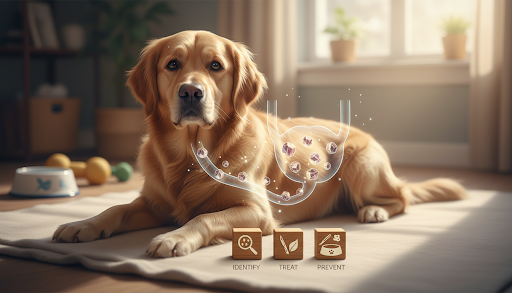
Causes and risk factors for the formation of kidney stones.
Kidney stones in dogs have different origins, depending on the type of substance accumulated. In some cases, it is multifactorial, meaning that several factors contribute to the development of the condition, as is the case with calcium oxalate stones.
Among the main ones, the following stand out:
Inadequate diet: excess of minerals such as calcium, phosphorus, and magnesium;
Altered urinary pH: favors different types of crystals;
Low water intake: more concentrated urine;
Urinary tract infections: alter the urinary environment;
Sedentary lifestyle: prolonged urinary retention.
In other cases, genetics plays a determining role, as is the case with uric acid or urate stones. Thus, some breeds have a greater predisposition to certain types of stones.
For example, Dalmatians have a tendency to develop urate stones.
In this sense, knowing an animal's DNA makes it possible to identify risks even before the first symptoms appear.
Diagnosis and treatment options
Diagnosis of kidney stones in dogs begins with clinical evaluation and laboratory tests.
Urinalysis is one of the main tests, as it allows for the identification of:
Urinary pH;
Presence of crystals;
Infections.
In addition, imaging tests such as ultrasound and X-rays are essential for locating and assessing the size of the stones.
Treatment varies depending on the type of kidney stone.
In some cases, especially with struvite, it is possible to dissolve the stones with a specific diet.
On the other hand, calcium oxalate stones do not respond to dissolution, requiring other approaches.
The main options include:
Cystotomy : surgery to remove stones;
Uro-hydropropulsion : elimination of small calculi;
Lithotripsy : fragmentation by shock waves.

Prevention: the best path to urinary health
Preventing urolithiasis in dogs is always the best strategy.
It is based on three main pillars:
Proper hydration;
Balanced diet;
Constant monitoring.
Encouraging water consumption is essential. To do this, you can use water fountains, place water bowls around the house, or add water to your food.
In addition, the diet should be guided by a veterinarian, especially in dogs with a history of the disease.
Another important point is to avoid unsuitable foods, such as snacks high in oxalate.
According to the Merck Veterinary Manual , the recurrence rate of urinary stones can reach 50%, reinforcing the importance of continuous monitoring.
Genetics and predisposition to urinary stones
Diet is not always the sole culprit. In many cases, genetic predisposition explains the development of the disease, and a genetic test can indicate the risk of future illness early on.
With advances in science, genetic testing is now able to identify alterations related to metabolism and the formation of kidney stones.
This allows for much more personalized and preventative care.
In this scenario, many pet owners wonder if the technology is worthwhile. The answer is yes, and many report that petgenoma is worth it precisely because of the predictability it offers.
Conclusion and preventive care regarding petgenoma.
Urinary health is fundamental to your pet's quality of life.
Understanding the signs, acting quickly, and investing in prevention are essential steps to avoid complications.
Furthermore, genetics should be seen as an ally. It doesn't determine the future, but it guides safer decisions.
petgenoma offers advanced technology so you can gain a deep understanding of your pet's health and adopt a preventative and personalized approach.
You can visit the unit at Av. Prof. Lineu Prestes, 2242 - Room 25 - Cidade Universitária, São Paulo - SP and follow educational content at @petgenomabr .
In this way, you transform information into care and ensure better health and longevity for your best friend.
Essay
Petgenoma



