Does racial purity always indicate that the pet conforms to the breed standard?
06/01/2026

This is a very common question related to breed composition results for purebred dogs: will every dog with a 100% result for a given breed necessarily resemble the breed standard? The answer is no! Breed purity and breed standard are not synonymous! Here we will explain why.
First of all, it's important to remember that not every purebred dog will be exactly 100% of a single breed. In some breeds with relatively high variability, it's common for purebred dogs to have, for example, 75% or 80% of the main breed composition, and this is not necessarily proof of mixed breeding. This topic is covered in another post on our blog, which you can access here .
But what happens when a purebred dog has 100% genetic makeup from a single breed ? This means we've found 100% of the "genetic signature" we know for that breed! And the genetic signature is determined from a set of dogs of that breed, previously evaluated in the laboratory, present in the "DNA bank". For example, let's say the petgenoma bank has 50 German Shepherd dogs: these dogs provide the expected pattern of genetic makeup for that breed, which is the breed's genetic signature. When a new dog is analyzed, its DNA is compared to this genetic signature, and to all the others from the more than 250 breeds present in our bank. If the analyzed dog shows compatibility with the entire genetic signature of the German Shepherd in our database, the report is issued with a composition of 100% German Shepherd.
However, it is very important to remember that this data is not synonymous with beauty, breed standard, or racial superiority, necessarily . Nor should it be used, in isolation, to decide whether or not to breed a purebred dog. Even dogs that are 100% of a single breed can deviate from the physical or temperament standard , one of the reasons why the decision to breed a dog is complex and should only be made by professional and responsible breeders.
The work of a good breeder involves, among many other things, the careful and continuous analysis of their dogs to detect minor faults or flaws (physical or behavioral). The breeder must know the breed standard very well and be able to detect any difference from this standard. In the figure below, we show a standard characteristic of the breed, popularly known as necessarily having an erect ear, and next to it, an ear that is outside the breed standard.

In the example below, you can see that if this breeder ignores that one of their dogs has this fault/defect, and chooses to breed it, the physical defect will persist, and may even become more evident, depending on the type of dog with which this first dog was bred. In the example used, the breeder allowed this dog born in the 2nd generation (“A2”) to be bred with another that had a similar physical fault (“B2”).
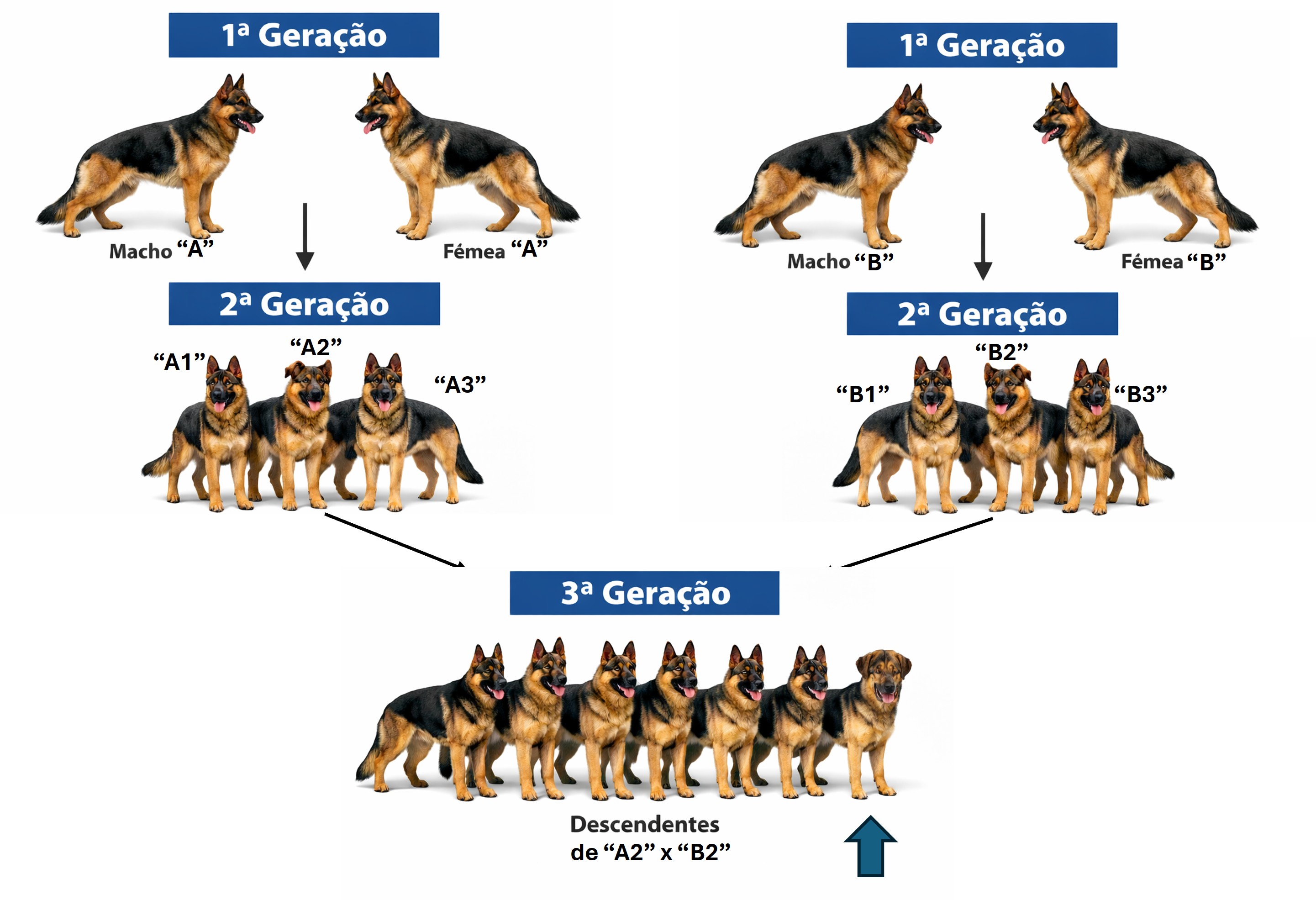
In the third generation, although it is possible for puppies to be born without this defect, it is also quite possible for puppies to be born with this problem even more pronounced, like the dog indicated by the arrow. If this breeder continues to reproduce this dog at this point, he will progressively produce, with each generation, dogs with physical faults that will accumulate, completely disqualifying the breed standard and producing dogs very different from the breed standard .
The image below shows a possible result of breeding this non-standard dog: 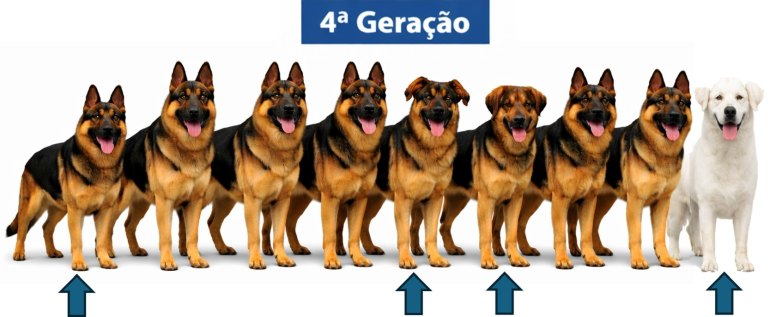
To reach the point of, for example, producing a puppy with a non-standard color (like the white puppy on the right shown in the 4th generation), or a puppy smaller than the breed standard size (like the puppy on the left shown in the 4th generation), in addition to dogs with "minor" faults such as floppy ears (like the 5th and 6th dogs), which were not the result of mixing with another breed . Therefore, dogs outside the standard are not always the result of crossbreeding . Often, these dogs exist simply because the person responsible for breeding them was not a true breeder and simply allowed the dogs to reproduce randomly and without selection or direction, which is the main function of a responsible breeder! Finally, remember that the speed at which faults appear and become pronounced is likely not as great as demonstrated in this text, which aimed to explain the process over a few generations, for simplicity. A more realistic situation would involve minor flaws occurring and becoming more pronounced over several generations, right?
Therefore, racial purity is the only factor that can indicate whether or not there has been crossbreeding in recent generations , but it is not the only factor that should be taken into account when deciding whether or not to breed a dog !
Fabiana Michelsen de Andrade
Geneticist specializing in small animals.
Biologist, Master's and PhD from UFRGS.
Postdoctoral studies in Cellular and Molecular Biology (United Kingdom) and in Animal Genetic Improvement (UFRGS)
Founding partner and scientific director of petgenoma



